Spain's Second Train Crash Kills 69, Straining Rail Safety Before Election
A collision in central Spain marks the second deadly accident on the Madrid-Seville line this year, prompting a three-day national mourning and new scrutiny of the rail network.
By Luana Foster ·
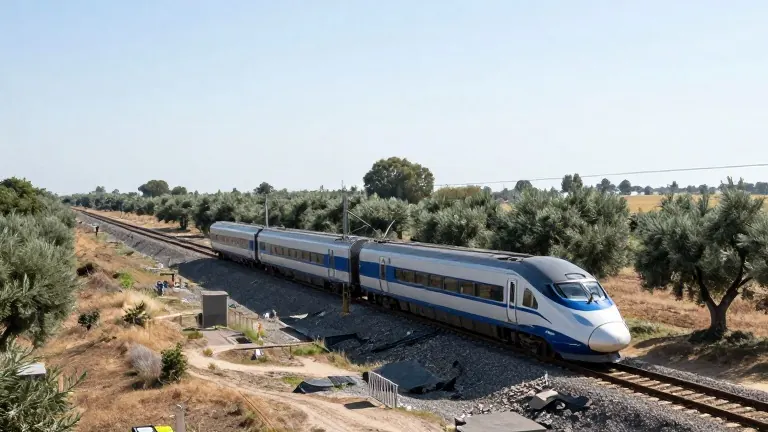
Spain declared three days of mourning following a high-speed rail collision in central Spain that killed 69 people. The crash occurred Wednesday morning near the village of Urda, where one train struck another from behind. This incident marks the second fatal disaster on the country’s rail network this year. Prime Minister Pedro Sánchez pledged a full investigation and safety improvements to restore public confidence in the system.
Search teams with sniffer dogs continued operations on Thursday to locate missing victims. Cranes moved the wreckage, which included at least three carriages thrown down a gravel slope. Police and soldiers worked to pick through the debris. Regional leader Emiliano García-Page reported that one more body was found overnight, bringing the total death toll to 69. He stated that 50 people remained hospitalized while officials worked with families to identify the deceased.
King Felipe VI visited injured passengers at a hospital in Toledo and described the event as a devastating blow to society. He said the nation must adopt measures to prevent such incidents from recurring. A minute of silence was held at noon across the country, with lawmakers gathered outside the Parliament and rail workers standing in Madrid’s main station. Survivors shared their accounts on Spanish television, including Pablo López, who described seeing a person crawl on the ground after being ejected from the other train.
The Madrid-Seville line, which opened in 1992, has been central to Spain’s reputation for high-speed rail. It is the world’s second-largest network after China’s. Before this year, the system had not seen a deadly crash in over three decades. In January, 46 people died after a train jumped the track and hit another in southern Spain. Both accidents this year occurred on the same line and involved state-owned RENFE and private operator IRYO. The rail liberalization that allowed IRYO to begin service in 2022 is now under closer review.
Transport Minister Óscar Puente attributed the crash to a specific sequence of events involving a central command center. He stated that a computer malfunction caused a security system to fail at 8:30 a.m., stopping all trains on the affected stretch. The IRYO train was stationary at the time, while the RENFE train was 25 kilometers behind. Minutes later, command ordered the RENFE train to start moving without speed restrictions. The collision happened at 8:53 a.m. Puente said the train should not have been given that order while a stop signal was active, or at least it should have been told to reduce speed.
Train unions held a planned strike on Thursday to demand safety upgrades that they say were promised after the January crash. Union leaders criticized the minister for focusing on a single controller and for allowing control room audio to be released to media. Pepa Páez of the CCOO union argued that the focus should be on system flaws rather than individual human error. A judge declared the crash site an investigation zone, and the Madrid-Seville high-speed line remains shut down, leaving thousands of travelers to find alternative transport.
The accident adds pressure to Prime Minister Sánchez ahead of the national election scheduled for November 29. He had called for early elections to capitalize on public discontent with housing costs and rents. Now, he faces criticism from right-wing parties over migration policies and corruption accusations against his party and his wife. Conservative leader Alberto Núñez Feijóo demanded a full investigation into the crash. Political science professor Alejandro Quiroga noted that while the news is not good for the Socialist Party, Spaniards often dislike politicians who try to capitalize on tragedies. He said it is too early to determine if the crash will significantly shift voter opinion.
Source: WSVN