Harvard Analysis Sets 10,000-Resident Cap for Sustainable Lunar Settlements
Water scarcity, not power, limits long-term moon habitation to small towns rather than the million-person cities envisioned by tech leaders.
By Luana Foster ·
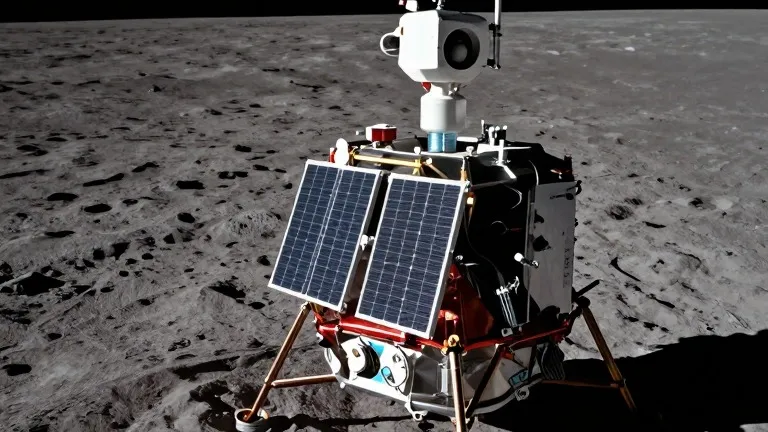
While major space companies pursue large-scale lunar development, a new scientific analysis suggests the moon's water reserves are insufficient to support the massive populations currently projected by industry leaders. The study, published in Frontiers in Space Technologies, evaluates the feasibility of permanent settlements based on available resources.
Martin Elvis, a senior astrophysicist at Harvard University's Smithsonian Astrophysical Observatory, and Jonathan McDowell, an honorary professor at the Durham University Space Research Centre, conducted the review. They assessed the energy and water requirements for sustaining human life on the lunar surface. Their work responds to public claims made by high-profile executives regarding the timeline and scale of future moon cities.
Elon Musk, CEO of SpaceX, stated in February that the company is prioritizing a self-growing city on the moon, which he believes could be established in under 10 years. Jeff Bezos, CEO of Blue Origin, has similarly predicted that millions of people will live in space by 2045. The Harvard and Durham researchers tested these claims against current geological estimates.
Power generation appears manageable, with solar and nuclear sources capable of supporting a population of one million. Water, however, presents a severe constraint. The moon holds approximately one billion tonnes of water, mostly located in permanently shadowed regions at the poles. Assuming 98% recycling efficiency, comparable to rates on the International Space Station, a million-person population would deplete this supply in roughly 100 years.
A settlement of 10,000 people, by contrast, could remain sustainable for centuries under the same assumptions. Elvis described the total water volume as modest, comparing it to an aquarium the size of Central Park filled to the level of the Statue of Liberty. He noted that a small lake cannot supply a large city indefinitely.
The researchers' baseline assumption of one billion tonnes may be optimistic. Elvis estimates that only 20% to 30% of that figure is accurate, and that only one-third to one-half of the present water is recoverable. His best estimate suggests the usable amount is about 1% of the original figure, which would reduce the 100-year supply for one million people to just one year.
Gordon Osinski, a professor of planetary geology at Western University, noted that satellite data contains uncertainties and that ground confirmation is needed. He suggests the water may exist as sub-millimetre ice crystals mixed into soil, similar to Arctic permafrost, making extraction difficult. McDowell emphasized that the findings are factual rather than discouraging, stating that negative outcomes only result from attempting projects that are not viable.
Source: CBC News