Documentary Detective: Lynne Sachs Reconstructs Past Lives Through Old Business Cards
The filmmaker hired a professional investigator to trace the people behind her preserved contacts, a process she describes as dealing with the residue of shared history.
By Victoria Singh ·
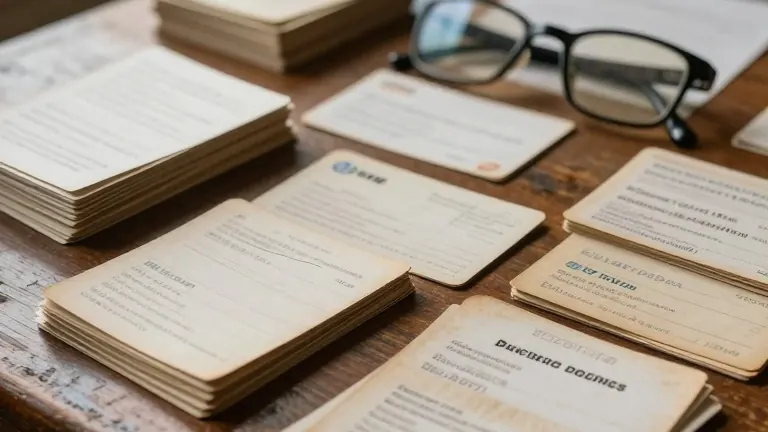
U.S. artist and documentarian Lynne Sachs has hired a professional detective to investigate the people behind a box of hundreds of old business cards. This unconventional method forms the core of her newest film, “Every Contact Leaves a Trace,” which is currently screening at the Ji.hlava Documentary Film Festival in its Czech premiere.
Sachs has attended Ji.hlava previously, but this is the first time she has served on the jury in person. She sits on the First Lights jury, a panel that evaluates documentary debut films. She noted that the festival’s lineup offers a diverse range of global perspectives. “There are about 24 movies to see. It’s kind of revelatory,” Sachs said. She pointed to specific films from Argentina and the Congo as examples that challenge standard documentary paradigms.
The concept of positionality drives the narrative of “Every Contact Leaves a Trace.” Sachs is visibly onscreen as she sorts through decades of cards, questioning whose perspective is being presented. She admits that many of the cards have lost their meaning over time, though some left strong impressions. These include an artist whose work touched her and a fellow filmmaker who was later canceled over allegations of impropriety. One card belonged to a Syrian refugee whose family discouraged her from appearing on camera, leading Sachs to film a tribute to the woman’s cooking instead.
Sachs prefers the term “on camera participants” over “protagonists” or “characters” to describe the people in her films. She emphasizes that the viewer is offered a chance to hear a story by the person behind the camera, but the identity of that person is often obscured. In this new work, she makes her role clear, occasionally seeking help from her niece and nephew as she tracks down individuals who likely did not expect a visit.
The investigation required more than just memory. At one point, Sachs engaged forensic investigators to analyze leads. She was most drawn to the cards that presented the biggest obstacles. Some contacts proved impossible to find, while others raised questions about whether the impact of the interaction was mutual. Sachs noted that human minds tend to edit or re-enact past encounters, often burning specific moments into memory. A family member suggested that individuals do not always choose which memories persist.
Since the film’s release, viewers have offered Sachs their own collections of old business cards. She declined these offers, explaining that each collection belongs to the specific person who held it. “You’re the person who had that dentist. You’re the person who met that psychoanalyst. Or potential friend on a bus,” she said. The process of recounting these encounters is fraught with traps, as memories are often unreliable.
Sachs discovered that she did not always need to travel across time zones to find former acquaintances. Some individuals might not even remember the interaction or consider it important. She stated, “I don’t need to prove I did or didn’t.” Her goal, she explained, is to deal with the residue left by these past connections.
The film concludes with Sachs reflecting on the interactions that left a mark on her life. She is attempting to reconstruct a life story from these fragments. The investigation into her own history serves as a detective story, using professional tools to uncover the traces of people who crossed her path.
Source: Variety