Tear Gas and Katana: 135 Detained as 70,000 Officers Guard France
Interior Minister Laurent Nuñez reports 135 arrests and a seizure of improvised weapons as authorities deploy 70,000 officers to prevent a repeat of last week's unrest.
By Victoria Singh ·
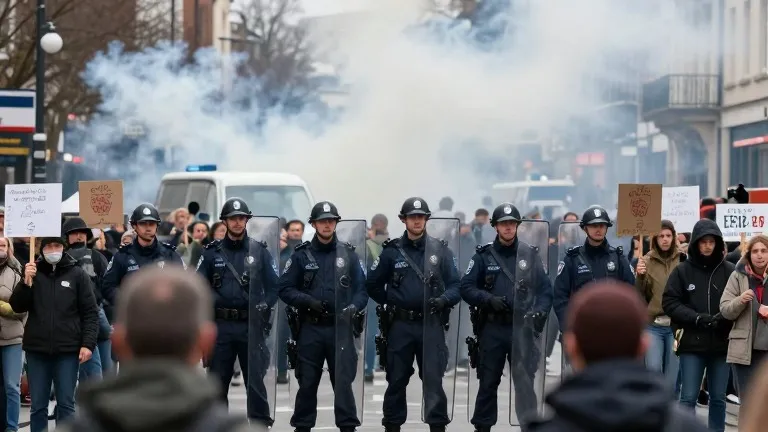
Saturday dawned with a heightened police presence in French cities, as authorities deployed 70,000 officers to guard against a repeat of the previous weekend's chaos. Interior Minister Laurent Nuñez confirmed that 135 people were detained during the demonstrations. Officers also seized a variety of weapons, including metal balls, lead pellets, fireworks, slingshots, steel balls, a katana, and airsoft guns. Nuñez stated that despite the heavy deployment, there had been no major incident in the country.
In Lyon, where local authorities had banned public demonstrations, tensions flared near the city center. Approximately 150 protesters attempted to block a road, prompting police to use tear gas to clear the area. A 21-year-old student who spoke to Agence France-Presse described the police response as highly mobile. The student noted that officers often dispersed marching groups before they could fully form.
The protests in Orléans targeted Marine Le Pen, who is using a party congress to launch her presidential campaign against Emmanuel Macron. Police counted 11,000 participants in the march, while organizers claimed the crowd reached 26,000. Marchers chanted slogans demanding Macron's resignation and Le Pen's imprisonment. About 50 groups, including unions and left-wing parties, had organized the event. French media reported the march ended peacefully in the early afternoon, with Le Pen's congress expected to continue through Sunday.
In Paris, the atmosphere was described as calm at the Porte d'Italie, the city's only authorized protest site. Police had moved the march from the planned location at Bastille to the southeastern edge of the city at the last minute. Murielle Guilbert, a union representative, called the move scandalous, arguing that Macron had barred protesters from demonstrating where they wished. She added that wages had not risen to the level they should. A student named Lucas told CBS that it was normal for people to be angry given the economic conditions.
The unrest has forced changes to daily life and major events in the capital. Many businesses have boarded up their windows, and major museums remain closed. Art Basel opened on Friday for a single day, with organizers canceling the weekend program to avoid crowds. The first NFL game in France, involving the New Orleans Saints, remains scheduled for Sunday, though some related venues were closed on Saturday. A soccer match between Paris Saint-Germain and Olympique Lyonnais, originally planned for Sunday, was moved to Monday night.
The current protests follow a surge of unrest that began last month when high school students in southeast Paris demanded better conditions. The movement widened as residents sought relief from rising living costs. About 3,000 shops across France were damaged or looted during the previous weekend's clashes. The Yellow Vests, a movement that emerged about eight years ago, have announced they will hold more demonstrations on Oct. 31. They plan rallies and a sit-in outside parliament and city halls, citing the government's authoritarian drift.
The economic and social strain has also triggered unrest elsewhere in Europe. Italy deployed additional soldiers to Milan following looting and clashes, while Premier Giorgia Meloni announced tougher penalties for minors involved in the violence. In Tirana, Albania, riot police used water cannons on students demanding lower tuition. Thousands of retirees marched in Madrid over pension issues, and a housing protest was expected in Lisbon.
Source: CBS News