NASA plans 14-day Earth orbit test using three different rockets
The agency will launch New Glenn, SLS, and Starship to check lander systems before the 2028 moon landing attempt.
By Pedro Salazar ·
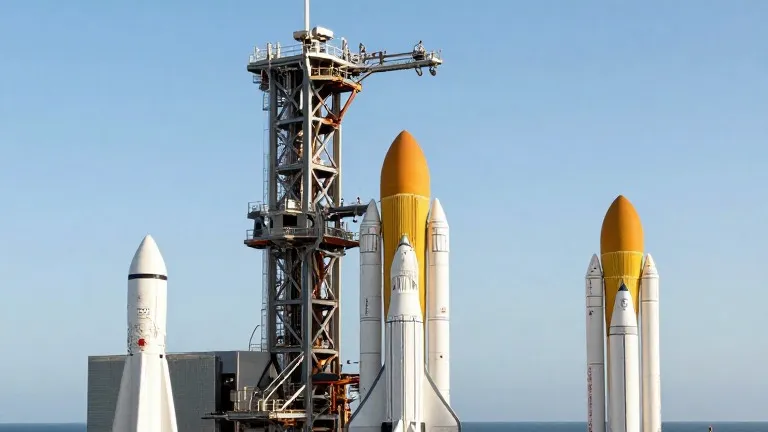
NASA will put three different rockets to work in a single orbital test this summer.
The agency outlined the operation on Thursday at a press conference at Kennedy Space Center in Florida. Program manager Jeremy Parsons described the effort as likely the most complicated launch campaign ever undertaken. The mission spans 14 days and could stretch to 17 if delays occur. It is designed to validate hardware before astronauts attempt a lunar landing in 2028.
The sequence starts with Blue Origin’s New Glenn rocket. That vehicle will carry the Blue Moon lander into low Earth orbit. Next, NASA’s Space Launch System will launch the Orion spacecraft carrying four astronauts. The crew includes NASA’s Randy Bresnik, Andre Douglas, and Frank Rubio, along with Luca Parmitano from the European Space Agency. SLS will place Orion in a highly elliptical orbit that ranges from 18 miles to 1,122 miles in altitude. The capsule will then adjust its path to an orbit about 345 miles high to manage thermal stress.
The crew will spend two days checking Orion’s systems. On the third day, they will dock with the Blue Moon lander at an altitude of 273 miles. The two vehicles will stay connected for two days while the astronauts test life support and environmental controls. Around the sixth day, SpaceX’s Starship will launch with a special docking adapter. It will meet Orion on the eighth day at an altitude of 237 miles. That encounter will last only about two hours, and the crew will not enter the vehicle. The goal is to collect data on docking forces.
After undocking from Starship, the mission will continue for six to nine more days before the crew splashes down in the ocean using parachutes. During this time, the astronauts will test survival suits and perform health assessments. These tasks were not completed during the 10-day Artemis II flyby in April.
The results will help determine which lander flies the Artemis IV mission near the moon’s south pole in 2028. That would be the first crewed lunar landing since Apollo 17 in 1972. Administrator Jared Isaacman said the agency is keeping both options open. He noted that NASA has no intention of surrendering a viable path to the surface before the data and schedule require it. Both providers are planning lunar landing missions for that year, but their approaches differ. Blue Origin’s plan involves meeting Orion in lunar orbit, while SpaceX’s likely involves docking in Earth orbit and propelling the capsule toward the moon.
NASA is targeting a launch for summer of next year. However, an internal memo last month indicated the mission is about 90 days behind schedule. Parsons identified the lunar lander supply chain as a major challenge. Despite the delays, Isaacman said the team is moving with real speed and purpose.
Source: Space.com