Khmara: Ukraine Drone Speeds Return to 400km/h After Starlink Limits Lifted
Ukraine's defense minister confirmed full satellite connectivity on Saturday, ending a week of restrictions that hampered military drone operations.
By Victoria Singh ·
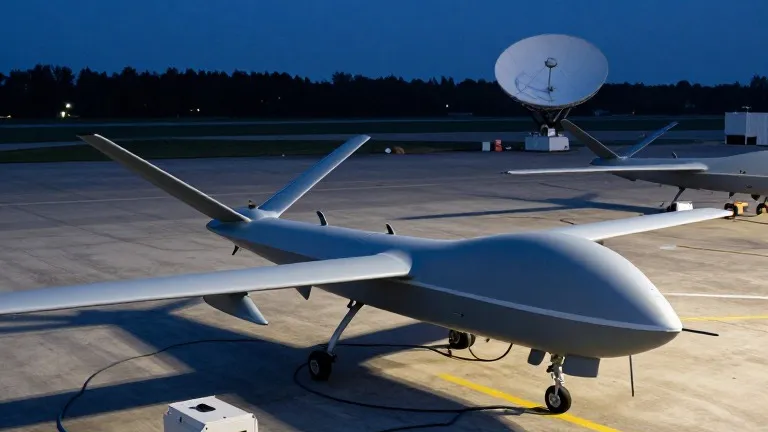
Ukraine has confirmed that its military drones are again capable of flying at speeds exceeding 400km/h, signaling that full access to the Starlink satellite network has been restored. Defense Minister Yevhenii Khmara announced the change in a statement on Saturday, marking the end of several days during which the armed forces operated under strict connectivity limits.
The restoration of speed caps directly addresses a critical operational bottleneck for Ukrainian forces. Khmara stated that the return to full capability is vital for frontline soldiers, drone operations, logistics, and communications. The specific metric of 400km/h serves as a technical benchmark indicating that the network no longer drops connections during high-speed maneuvers.
The restrictions emerged after Ukrainian officials accused US President Donald Trump of instructing Elon Musk, the owner of Starlink, to impose limits on the service. Under these constraints, drones reportedly lost their satellite link when traveling at speeds of 161km/h or faster. Trump initially denied issuing such an order but later acknowledged that Musk had resolved the issue. The dispute coincided with a wider diplomatic disagreement between Trump and President Volodymyr Zelensky regarding Ukrainian strikes on Russian oil infrastructure.
Ukraine relies heavily on both the civilian Starlink service and the military-grade Starshield system to pilot drones and coordinate operations, particularly in remote battlefield areas. Musk has indicated that Starshield is controlled by the US military, suggesting the Pentagon may have been involved in the recent connectivity issues. The network is essential because Russia is not authorized to use Starlink, creating a blind spot when Ukrainian long-range assets strike deep inside Russian territory, such as oil refineries.
Context for the conflict includes Trump's waiver of some sanctions on Russia and a deal to import Russian diesel ahead of midterm elections next month. Trump argues that Ukrainian strikes on refineries have raised global fuel prices, while Kyiv maintains the attacks are necessary to cut Moscow's war revenue. Zelensky claimed the US threatened to withdraw intelligence sharing if the strikes continued, a claim Trump denied.
On the ground, Russia's defense ministry reported on Saturday that its air defenses shot down 616 Ukrainian fixed-wing drones. These drones struck several regions, including Russian-annexed Crimea, where Governor Sergey Aksyonov said electricity and water restrictions were imposed due to power cuts from the strikes. Ukrainian authorities stated they hit a missile component manufacturer, a chemical plant, and an aircraft at a military airfield within Russia over the past 24 hours.
Ukraine also reported that Russia carried out 88 air strikes on Friday, deploying 309 glide bombs and 10,270 kamikaze drones. The restoration of Starlink speeds allows Ukrainian command to maintain the rapid, coordinated drone attacks that have become a central feature of the current phase of the war.
Source: BBC News