Powerful Quake Rocks Northern Tibet, Killing 16 and Destroying Hundreds of Homes
A magnitude 7 earthquake struck the Nagqu area late Thursday, causing significant structural damage and triggering a large-scale rescue operation.
By Luana Foster ·
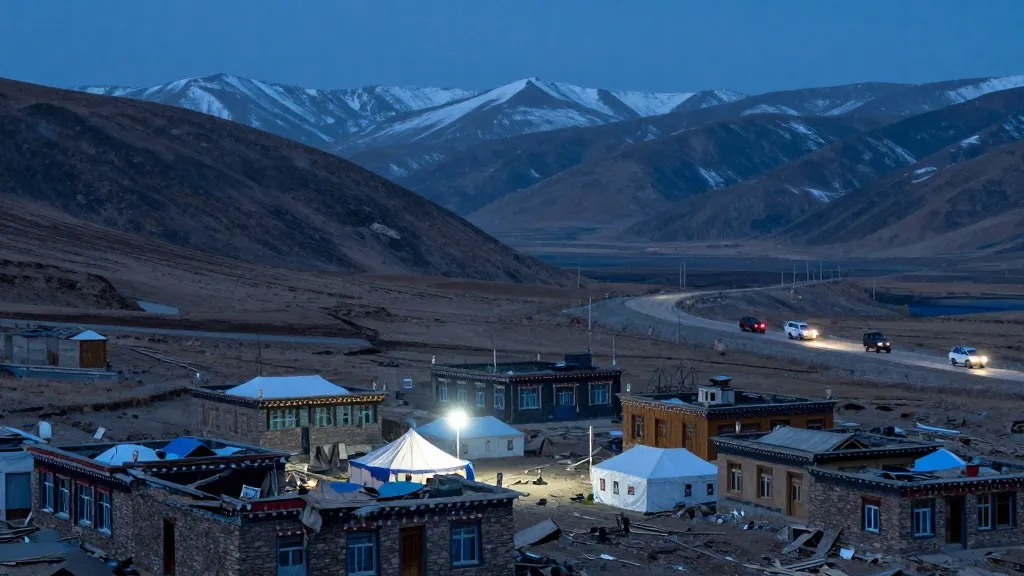
China’s Tibet region was struck by a magnitude 7 earthquake on Thursday evening, resulting in at least 16 deaths and 46 injuries. The seismic event caused widespread destruction, particularly around the northern city of Nagqu, where hundreds of residential structures collapsed. Official media outlets confirmed the casualty figures as search and rescue teams continued their work through the night and into Friday.
Local authorities in Nagqu provided specific details on the extent of the damage. The city media office, referencing government data, stated that at least 339 homes and 20 livestock sheds were destroyed. Among the injured, 11 people are in serious condition, while the other 35 sustained minor injuries. Rescue operations remain active as crews work to locate survivors and assess further structural stability in the affected zones.
The response effort has mobilized significant local resources. More than 1,600 personnel from the local county have been dispatched to the site to assist in rescue operations. In parallel, relief supplies have begun arriving in the region to support displaced residents. These supplies include 1,000 prefabricated housing units, approximately 3,000 tents and folding beds, flashlights, and winter clothing to help those who have lost their homes.
Infrastructure has been disrupted by the quake. Xinhua, the state news agency, reported that communication networks are down in parts of the region. In response, local railway authorities implemented emergency measures to halt train traffic through the affected area. This decision aims to ensure the safety of passengers and allow for a thorough inspection of the tracks before service resumes.
Road access has also been restricted to facilitate cleanup and rescue efforts. The earthquake triggered rockfalls that blocked sections of National Highway 317. Officials have closed this stretch of the highway, permitting only emergency, rescue, and official support vehicles to pass. Crews are currently working to clear the debris and make the route safe for general traffic.
Weather conditions are expected to add complexity to the ongoing operations. According to Xinhua, intermittent snow is forecast for the earthquake zone over the next three days. This weather pattern may slow down rescue teams and complicate the distribution of aid, requiring careful planning from local coordinators.
The event has been identified as a major seismic occurrence for the area. China’s national broadcaster, CCTV, described the earthquake as the strongest in the region in the past five years. This characterization underscores the rarity of such a powerful event in the local geological history, highlighting the need for robust infrastructure and preparedness in high-altitude areas.
Scientific data provides further context on the quake’s mechanics. The U.S. Geological Survey recorded the earthquake at 10:33 p.m. local time. It occurred at a depth of 18 kilometres, with the epicenter located 191 kilometres east-northeast of Nagqu. The area is sparsely populated and situated at a high altitude in northern Tibet.
Geographically, Nagqu is positioned more than 300 kilometres north of Lhasa, the capital of the Tibetan region. The remote nature of the epicenter and the challenging terrain present logistical hurdles for relief efforts. As the situation evolves, authorities are monitoring both the physical damage and the environmental factors that could impact recovery timelines.
Source: CBC News