Micron's next memory chips will store twice as much data in late 2027
The company says its G11 generation reaches about 42 Gb/mm2 by bonding two wafers together, a step rivals are also taking.
By Pedro Salazar ·
Micron expects to begin ramping a new flash memory generation in the second half of 2027 that packs roughly double the storage into the same chip area as its current parts. The company outlined the G11 design at an event this week, saying it will also move data faster while drawing less power per bit.
In triple-level-cell form, density rises from about 21 Gb/mm2 in the current G9 parts to about 42 Gb/mm2 in G11. Input and output speeds reach up to 5,400 MT/s, up from 3,600 MT/s, a gain of up to 50%. Energy used to transfer each bit falls by more than 25%. Micron says the density figure is higher than the next-generation NAND from Kioxia, called BiCS10, and Samsung's V10.
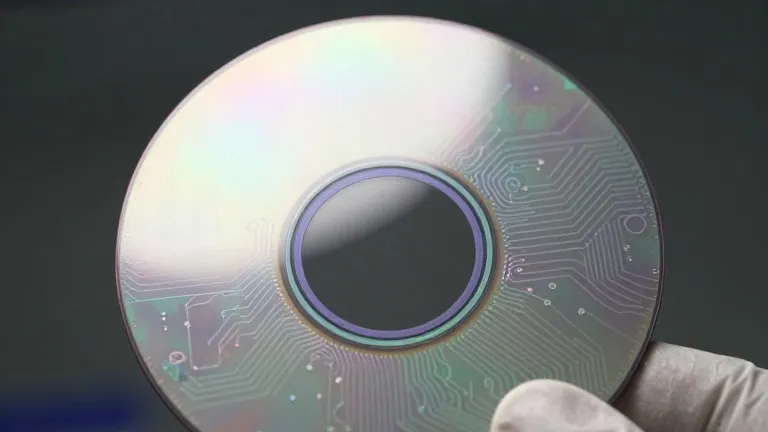
The main design change is wafer-on-wafer bonding. Micron builds the memory array on one wafer and the peripheral circuitry and input/output on another, each with a process fitted to its task, then bonds the pair. The company has used CMOS-under-array layouts for several generations. YMTC, a Chinese manufacturer, already uses this bonding method.
G11 also moves past 400 layers. Micron has not given the number of active wordline layers or memory decks, and says only that the design will carry an industry-leading memory cell pitch. The company plans to release more technical details in 2027 near the start of high-volume production.
Scott DeBoer, Micron's president and chief technology and products officer, said the company had previously said it would use the technique when it became cost-effective and matched product requirements. "This is the right timing for that technology," he said, calling G11 "the world's most advanced NAND" and confirming it uses wafer-on-wafer bonding.
Micron says it is working on high-mobility materials, denser cell layouts and lower-energy devices and data paths after G11. DeBoer said the company's roadmap covers new materials, densifying cell architecture and continued XYZ scaling. Micron has not released density targets or production schedules for generations past G11.
Demand for storage built on NAND remains strong, and adding layers remains one of the simplest ways to raise density.
Source: Tom's Hardware